
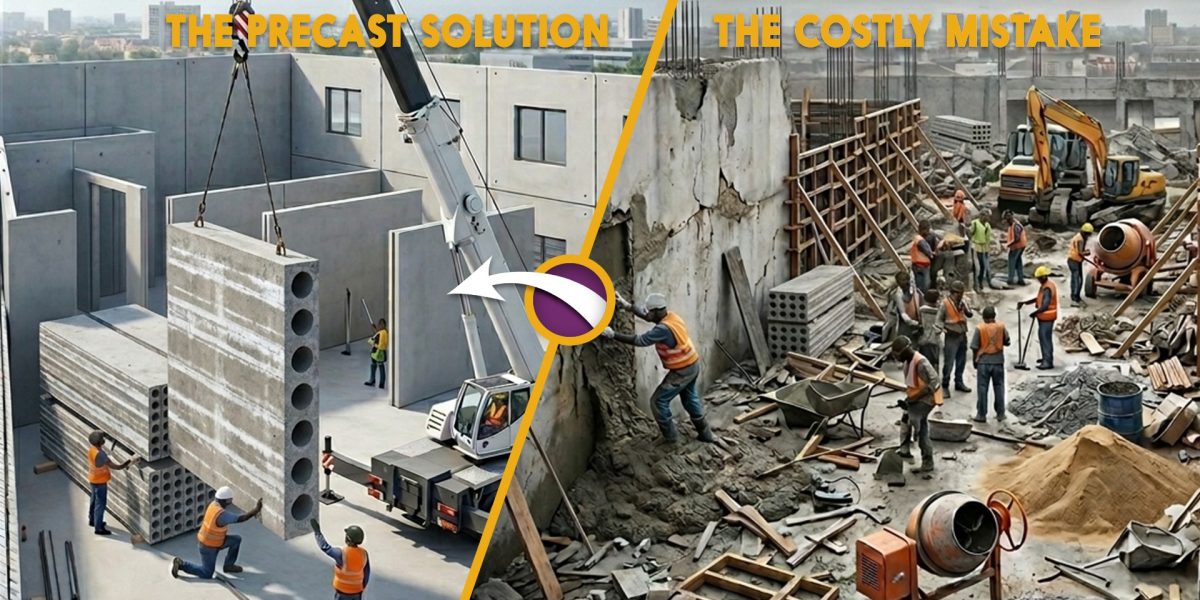
If you’ve ever been involved in a construction project in Kenya — whether as a developer, contractor, or property owner — you already know how quickly things can go off track.
Budgets stretch. Timelines slip. Quality becomes inconsistent.
And in many cases, it’s not because of poor planning or lack of effort.
It’s because of a few common mistakes that keep showing up across projects — mistakes that cost time, money, and long-term performance.
But here’s the good news.
Most of these issues are avoidable.
And with modern construction methods like precast technology, they can be solved faster and more efficiently than ever before.
In this article, we break down 7 costly construction mistakes builders in Kenya keep making — and how precast concrete solutions are helping fix them.
Why These Mistakes Keep Happening
Construction in Kenya faces real challenges:
- Rising material costs
- Tight deadlines
- Skilled labor shortages
- Weather disruptions
- Quality control issues
Traditional building methods often struggle to handle these variables.
That’s why even experienced builders find themselves dealing with delays, cost overruns, and inconsistent results.
Precast construction offers a different approach — one that removes many of these uncertainties by shifting critical processes off-site into controlled environments.
Let’s look at where things usually go wrong.
1. Poor Time Management and Delays
One of the biggest frustrations in construction is projects taking longer than expected.
Delays can come from:
- Slow on-site work
- Weather interruptions
- Coordination issues between teams
With traditional methods, everything happens sequentially. You wait for one stage to finish before starting the next.
How precast fixes this:
Precast components are manufactured off-site while foundation work is ongoing. This parallel process significantly reduces overall project timelines. Once delivered, installation is fast and efficient.
2. High Labor Costs and Inefficiency
Labor is one of the most expensive parts of any construction project.
Traditional construction requires:
- Large teams
- Continuous supervision
- High coordination
More people on site often means more room for error.
How precast fixes this:
Precast systems require fewer workers on-site. Installation is simpler, faster, and more controlled — reducing both labor costs and management complexity.
3. Material Wastage
Cement, sand, ballast — a lot of material goes to waste during conventional construction.
This not only increases costs but also creates unnecessary site mess and inefficiencies.
How precast fixes this:
Precast elements are produced in factories with precise measurements and optimized material use. Waste is minimized, and what remains is often recycled.
4. Inconsistent Quality
On-site construction depends heavily on workmanship, weather, and supervision.
This often leads to:
- Uneven finishes
- Structural inconsistencies
- Rework and corrections
How precast fixes this:
Precast components are manufactured under strict quality control. Each panel, beam, or block is consistent in strength, size, and finish — ensuring uniform results across the project.
5. Unpredictable Costs
Many construction projects in Kenya exceed their original budgets.
Why?
Because costs fluctuate due to:
- Material price changes
- Labor inefficiencies
- Rework
How precast fixes this:
Precast offers more predictable pricing. Since production is standardized and waste is reduced, developers can plan and budget with greater accuracy.
6. Site Congestion and Safety Risks
Busy construction sites can quickly become chaotic.
Multiple materials, workers, and processes happening at once increase the risk of:
- Accidents
- Delays
- Mismanagement
How precast fixes this:
With fewer materials and less on-site activity, precast construction keeps sites cleaner and more organized. This improves safety and overall workflow efficiency.
7. Long-Term Maintenance Issues
Some construction decisions may seem cost-effective in the short term but lead to higher maintenance costs later.
Problems like:
- Cracking
- Poor finishes
- Structural weaknesses
can reduce the lifespan of a building.
How precast fixes this:
Precast concrete is dense, durable, and manufactured under optimal conditions. This results in structures that last longer and require less maintenance over time.
The Bigger Picture: Why Precast Is Changing Construction in Kenya
Across Kenya, developers and contractors are beginning to rethink how they build.
From residential homes to commercial developments, precast technology is becoming a preferred choice — not just for speed, but for reliability.
By addressing the most common construction mistakes, precast systems offer:
- Faster project delivery
- Better cost control
- Higher structural quality
- Reduced waste
- Improved safety
It’s not just about building faster.
It’s about building smarter.
Final Thought
Construction doesn’t have to be unpredictable, slow, or expensive.
Most of the challenges builders face today come down to the methods being used.
By avoiding these 7 costly mistakes — and adopting precast concrete solutions — you can take control of your project’s timeline, budget, and quality.
The difference is clear:
Traditional construction reacts to problems.
Precast construction prevents them.
If you’re planning your next project, the question isn’t whether you can afford to use precast.
It’s whether you can afford not to.