
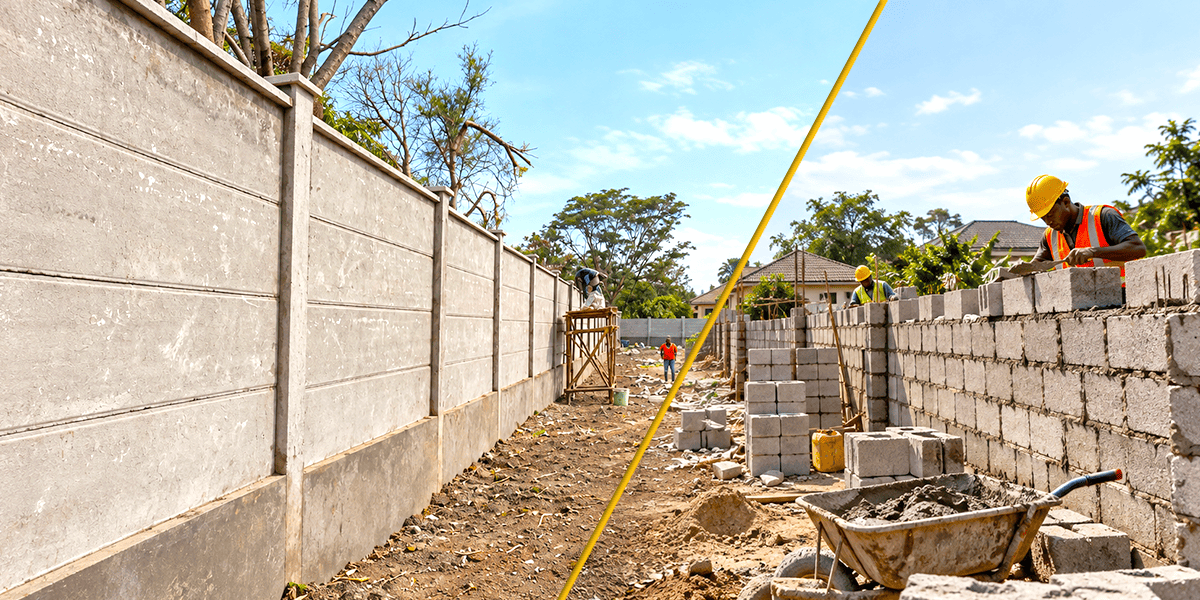
When someone decides to build a wall, one of the first questions they usually ask is simple: How much does it cost to build a wall in Kenya? It is a reasonable question. Construction is expensive, budgets are tight, and everyone wants to get the best value for their money. So naturally, a contractor or property owner will compare the price of concrete blocks, precast wall panels or other walling materials before making a decision.
But there is a problem with looking at construction materials this way. The price you pay for the material is only one part of what the wall will eventually cost you. A wall that looks cheaper when you buy the materials can end up being more expensive once you add labour, cement, sand, mortar, plastering, finishing, wastage, supervision and, perhaps most importantly, the time it takes to complete the work.
This is where many construction decisions go wrong. We compare the price of materials instead of comparing the cost of the finished wall. Think about conventional masonry. You buy the blocks, but that is only the beginning. Someone has to prepare the foundation, mix mortar, move materials around the site and lay the blocks one by one.
The wall then needs to be aligned, checked and eventually finished. Depending on the type of wall and the desired appearance, you may also need plastering, rendering or painting. Each of these activities adds another cost. There is also the cost of labour.
Building a wall block by block is labour-intensive, particularly when the project involves a large perimeter. The more time the project takes, the more days you are paying workers, supervising the site and dealing with the logistics that come with keeping a construction site running. These factors all contribute to the total perimeter wall construction cost.
And then there is something that rarely appears clearly on a quotation: time. A delayed construction project does not simply mean that the wall is completed later. It can affect everything around it. You may have to keep workers on site for longer. Equipment remains engaged. Materials have to be stored and protected.
A developer may have to wait longer before occupying or using the property. For a commercial project, delays can have an even bigger financial impact. This is why two walls with completely different material prices can sometimes end up costing surprisingly similar amounts, or why the apparently more expensive option can actually deliver better value.
Precast construction changes part of this equation because the manufacturing process happens in a controlled environment before the product reaches the site. Instead of producing the wall piece by piece on site, precast concrete wall panels are manufactured to specific dimensions and then transported to the project for installation. This approach to precast walling in Kenya allows much of the work to be done before the installation team even arrives at the site.
It can offer faster installation, reduced site labour, less material wastage and consistent factory production. That does not mean precast is automatically the right solution for every wall or every project. Construction decisions should always consider the specific site, design requirements, structural considerations, access, transport and budget.
But it does mean that the conversation should be bigger than the price of one panel compared with the price of one block.
Consider what happens during installation. With a conventional block wall, the construction process involves laying individual units, maintaining alignment, mixing mortar and allowing different stages of the work to progress before finishing can take place. With a properly designed precast walling system, larger components can be installed as part of an integrated system.
At Kingdom Precast Solutions, products such as precast wall panels, U-channels and H-beam posts are designed to work together, which can simplify the installation process and reduce the amount of site-based work required. The difference becomes particularly important when you are working on a large project. If you are putting up a small wall at home, saving a few days may not seem significant.
But if you are securing several acres of land, developing multiple properties or working on a project where every additional day affects your budget, construction speed becomes an economic consideration. This is one reason property owners compare precast wall panels vs concrete blocks when choosing a walling solution.
There is another issue worth discussing: finishing. One of the advantages of manufacturing concrete components under controlled conditions is consistency. The moulds, production process and curing conditions can be controlled more closely than many site-based processes.
Depending on the product and the project requirements, this can produce a more consistent surface finish and reduce the amount of additional finishing work required. With Kingdom Precast Solutions' precast concrete wall panels, the finish can reduce the need for plastering, depending on the desired appearance and project requirements.
Again, this does not mean that every precast wall requires no finishing or that every conventional wall requires extensive finishing. The final requirements depend on the product, design and desired appearance. The point is that these costs need to be considered when comparing the cost of precast walling with traditional walling.
There is also material wastage. Construction sites are rarely perfectly efficient. Materials get damaged during handling. Mortar gets mixed in excess. Offcuts and broken pieces accumulate. Sand and cement can be wasted through poor handling or inaccurate mixing.
Factory production does not eliminate waste, but controlled manufacturing can provide greater consistency in the use of materials and production processes. For a business trying to manage construction costs carefully, that matters. When evaluating cost-effective wall construction in Kenya, reduced wastage is another factor worth considering alongside labour and finishing expenses.
Perhaps the biggest mistake, however, is assuming that the lowest initial price automatically represents the best value. It doesn't. Good construction decisions are rarely about finding the cheapest individual component. They are about understanding the total cost of achieving the desired result.
So the next time you are comparing a traditional block wall with a precast walling system, don't stop at the question, "How much does this material cost?" Ask a few more questions.
• How much labour will I need?
• How long will installation take?
• How much mortar and finishing will be required?
• What level of wastage should I expect?
• How much supervision will the project require?
• What happens if the project takes longer than planned?
• And ultimately, what will the completed wall cost me?
That is a much more useful comparison.
The future of construction will not necessarily be about replacing every traditional method with a new one. It will be about making better decisions, choosing construction methods based on the full cost, the project requirements, the quality required and the value delivered over the life of the project. Comparing precast walling vs traditional walling should therefore involve more than material prices; it should consider the complete construction process.
For property owners, contractors and developers, that shift in thinking can make a significant difference. Because sometimes, the material that looks cheapest on the quotation is not the material that costs you the least. The real question is not "What does the wall cost?" It is "What does it cost to build the wall, finish it, maintain the site and get the project completed?" That is where the true cost of construction begins to reveal itself.